Business anthropology is the application of anthropological methods - ethnographic observation, participant immersion, and cultural analysis - to the study of organizations, consumer behavior, and product design. Where conventional business research asks people what they think and do, business anthropology watches what they actually do. The gap between those two answers is, reliably, where the most instructive intelligence sits.
- Business anthropology covers three distinct subfields - organizational culture, consumer behavior, and product design - each requiring different methods and a different kind of engagement
- Anthropologists treat organizations as cultures rather than as entities that merely have cultures - a distinction that changes how problems are framed and diagnosed
- Ethnographic methods capture what employee surveys structurally cannot: the gap between stated values and observed behavior
- Companies from P&G to Samsung have used business anthropology to surface consumer needs that could not have been reached through interviews or questionnaires alone
- A business anthropology engagement requires sustained observation - the depth of what it produces is proportional to the time spent in the field
Business Anthropology Is Three Disciplines Sharing a Name
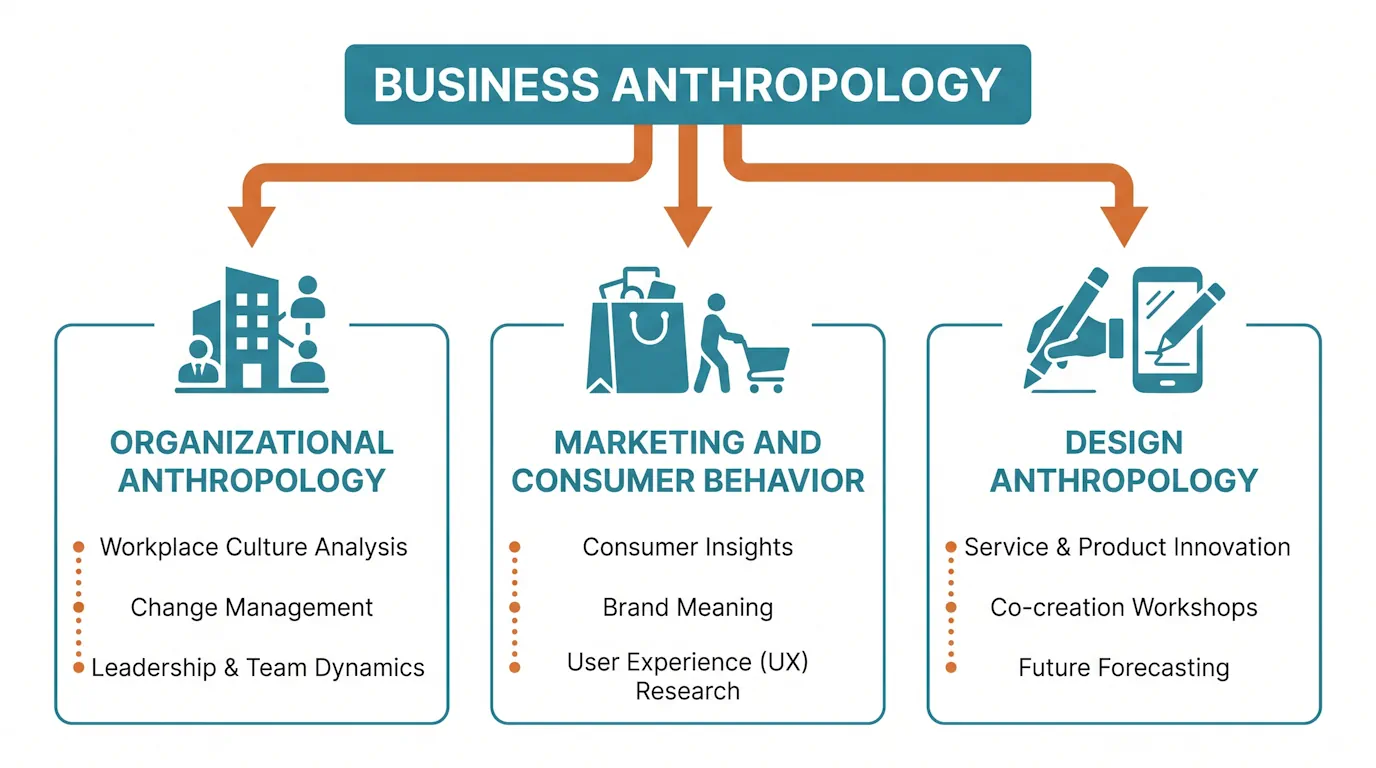
Most executives who encounter the term for the first time assume it refers to studying corporate behavior in a vague, sociological way. That reading misses the precision of the field. Business anthropology is structured around three distinct subfields, each addressing a different set of organizational questions - and conflating them leads to commissioning the wrong kind of engagement for the problem at hand.
Organizational anthropology examines the internal life of companies: their power structures, informal hierarchies, rituals, and the often-unspoken rules that govern daily behavior. It is concerned with how culture shapes what actually gets done versus what is officially prescribed. Design anthropology applies the same observational discipline to product development, treating the relationship between users and objects as a subject of rigorous field study. Marketing and consumer behavior anthropology takes ethnographic research into the marketplace, examining why people buy what they buy and remain loyal to what they remain loyal to - looking for the cultural logic that purchasing decisions follow rather than the rational explanations people give for them after the fact.
| Subfield | Domain | Core Questions | Representative Methods |
|---|---|---|---|
| Organizational Anthropology | Internal company culture, structure, change management, HR challenges | Why do people behave this way here? What are the unwritten rules and how are they enforced? | Participant observation, ethnographic interviews, artifact analysis |
| Marketing & Consumer Behavior | Consumer decision-making, product adoption, brand meaning, purchasing rituals | What actually drives purchase behavior? What does this product mean in a person's life? | In-context observation, home visits, shop-alongs, in-use studies |
| Design Anthropology | Product-user relationships, unspoken user needs, use-in-context | How do people use this in their own environment? What workarounds have they built that we haven't seen? | Naturalistic field observation, co-design sessions, usability in natural settings |
An Organization Does Not Have a Culture - It Is One
The most consequential idea in business anthropology for any executive is also the one that takes the most time to sit with. Most frameworks for addressing organizational culture treat culture as a variable - one attribute among many that a company can score, benchmark against competitors, and adjust through policy changes or training programs. Anthropologists work from a fundamentally different premise.
From an anthropological standpoint, an organization does not have a culture the way it has a quarterly budget. It is a culture. The reward systems, promotion patterns, communication norms, physical space arrangements, meeting rituals, and informal power dynamics are not expressions of the culture - they are the substance of it. This is not a semantic distinction. It changes what you look at when something goes wrong, and it changes which diagnostic tools are even appropriate to reach for.
"Anthropologists see the organization as a culture. Its structure, reward systems, rules of behavior, and goals are all parts of that culture - not features that exist alongside it."
Oxford Research Encyclopedias, Business Anthropology
Research from the Berkeley-Stanford Computational Culture Lab, published in Harvard Business Review, put a concrete face on this problem. The team found that the values and beliefs people say are important to them are frequently not reflected in how they actually behave.[1] Conventional employee surveys produce static snapshots of organizations that are in constant motion - they capture declared attitudes rather than the behavioral patterns that actually govern daily decisions.
What most diagnostic tools measure, in other words, is organizational aspiration - not organizational reality. That gap is precisely what ethnographic study is built to close.
What Business Anthropologists Actually Do in the Field
The signature method of business anthropology is ethnography - not to be confused with a site visit or a structured employee workshop. Ethnography is extended, immersive study conducted in the natural setting of the subjects. For an organizational engagement, that means weeks or months embedded in the workplace: attending meetings, observing how decisions actually get made, tracing how information moves through informal channels, and watching how stated values interact - or fail to interact - with daily decisions. The length is not incidental. A rushed ethnography is a contradictory enterprise; the behavioral patterns that matter most are precisely the ones that take time to surface.
Three methods do the bulk of the work. Participant observation places the researcher inside the organization's daily routines, collecting data from what people do rather than what they report about their behavior. Ethnographic interviews are open-ended and situational, designed to surface the reasoning behind behavior - often through extended listening rather than direct questioning. Artifact analysis reads the physical and digital objects of an organization - office layouts, internal communications, documentation structures, how people organize their workspaces - as evidence of what the culture actually values rather than what it claims to.
"Ethnography is a very efficient tool to collect data about things people can't or don't know how to talk about. Instead of taking people's answers for granted, you observe and try to interpret why people are doing what they're doing."
Christian Madsbjerg, Partner, ReD Associates
| Dimension | Employee Survey | Ethnographic Study |
|---|---|---|
| Data type | Self-reported (what people say) | Observed (what people do) |
| Time frame | Snapshot at one point in time | Extended study over weeks or months |
| What it captures | Declared values and stated opinions | Actual behavior and informal norms |
| Known weakness | Low correlation with real behavior; social desirability bias | Requires significant time and field access |
| Output | Scores and aggregate percentages | Pattern analysis and root-cause findings |
| Best suited for | Tracking declared attitudes at scale | Diagnosing behavioral patterns and cultural root causes |
Five Organizations That Put Business Anthropology to Work
The case for the field is built from accumulated practice, not from argument. These five examples show what becomes visible when observation replaces assumption.
Procter & Gamble developed Swiffer after anthropologists observed home cleaning routines in households and noticed that people were spending a disproportionate amount of time cleaning the mop itself between uses - not the floor. The product redesign addressed a behavior that was invisible to anyone looking at sales data or asking consumers to describe their cleaning habits. Swiffer went on to generate over $500 million in annual sales.
General Mills commissioned ethnographic research into family breakfast behavior and found a marked gap between what parents said their ideal morning routine looked like and what actually happened at the kitchen table. Aspiration and reality diverged in ways no focus group could have surfaced, because the gap itself was invisible to participants. That research produced Go-Gurt: a product designed around the real routine, not the idealized one.
Absolut Vodka worked with a research firm that used ethnographic methods at social gatherings and found that liquor choice is driven by storytelling and social identity rather than taste. Taste is the stated reason; identity is the operative one. That finding reshaped the brand's entire marketing philosophy.
Samsung learned through corporate anthropology research that consumers were buying large television sets not for superior resolution but to enhance their living space. The finding - that a television is furniture before it is a screen - reshaped product design across the entire line.
Intel has embedded anthropologists within its strategy team to examine how consumers interact with technology in daily life. The work has informed product planning and industrial design in ways that consumer surveys had not reached - because the questions being asked were different in kind, not just in execution.
| Company | What Was Studied | What Researchers Found | What Changed |
|---|---|---|---|
| Procter & Gamble | Home cleaning routines observed in natural settings | People spent more time cleaning the mop than the floor | Created Swiffer; over $500M in annual sales |
| General Mills | Family breakfast behavior in the home | Gap between parents' aspirations and actual morning routines | Developed Go-Gurt to fit real behavior, not stated preference |
| Absolut Vodka | Social behavior at parties and gatherings | Liquor choice is driven by storytelling and social identity, not taste | Rebuilt marketing approach around narrative and identity |
| Samsung | Television use in the home environment | Consumers valued large TVs as home decor, not primarily for screen quality | Reshaped product design approach across the entire TV line |
| Intel | Consumer technology interaction in daily life | Gap between stated technology needs and observed behavior patterns | Informed product planning in ways surveys had not reached |
"If you don't understand your organization's culture, you're unlikely to be successful. Culture is all that stuff we socially acquire from other people and transmit to others - beliefs, values, ways of speaking, habits, and the unwritten rules of how things get done."
What Business Anthropology Is Not - Three Confusions Worth Clearing Up
Three disciplines are regularly confused with business anthropology, and the confusion costs organizations time when they are trying to select the right kind of study for a specific problem.
Organizational psychology studies individual and group behavior through a psychological lens, using psychometric assessments, standardized questionnaires, and controlled studies. Its unit of analysis is the person or the team. Business anthropology starts from a cultural unit of analysis: it asks what patterns govern group behavior and how those patterns are created, sustained, and transmitted across generations of employees. Neither discipline renders the other unnecessary - they answer different questions.
Management consulting examines organizational performance through strategy, process efficiency, and financial metrics. It is largely quantitative in its data and recommendation-focused in its output. Business anthropology is aimed at understanding the cultural logic underneath behavior - which matters most precisely when process changes alone have not shifted what people actually do. The two are often sequentially productive: anthropology diagnoses, consulting prescribes.
Traditional market research - focus groups, surveys, customer satisfaction questionnaires - asks consumers to articulate their preferences and anticipate their behavior. One of the more durable findings in consumer study is that people are poor predictors of their own purchasing decisions. Business anthropology does not ask; it observes. The difference is not marginal.
Four Conditions That Signal an Ethnographic Study Is Warranted
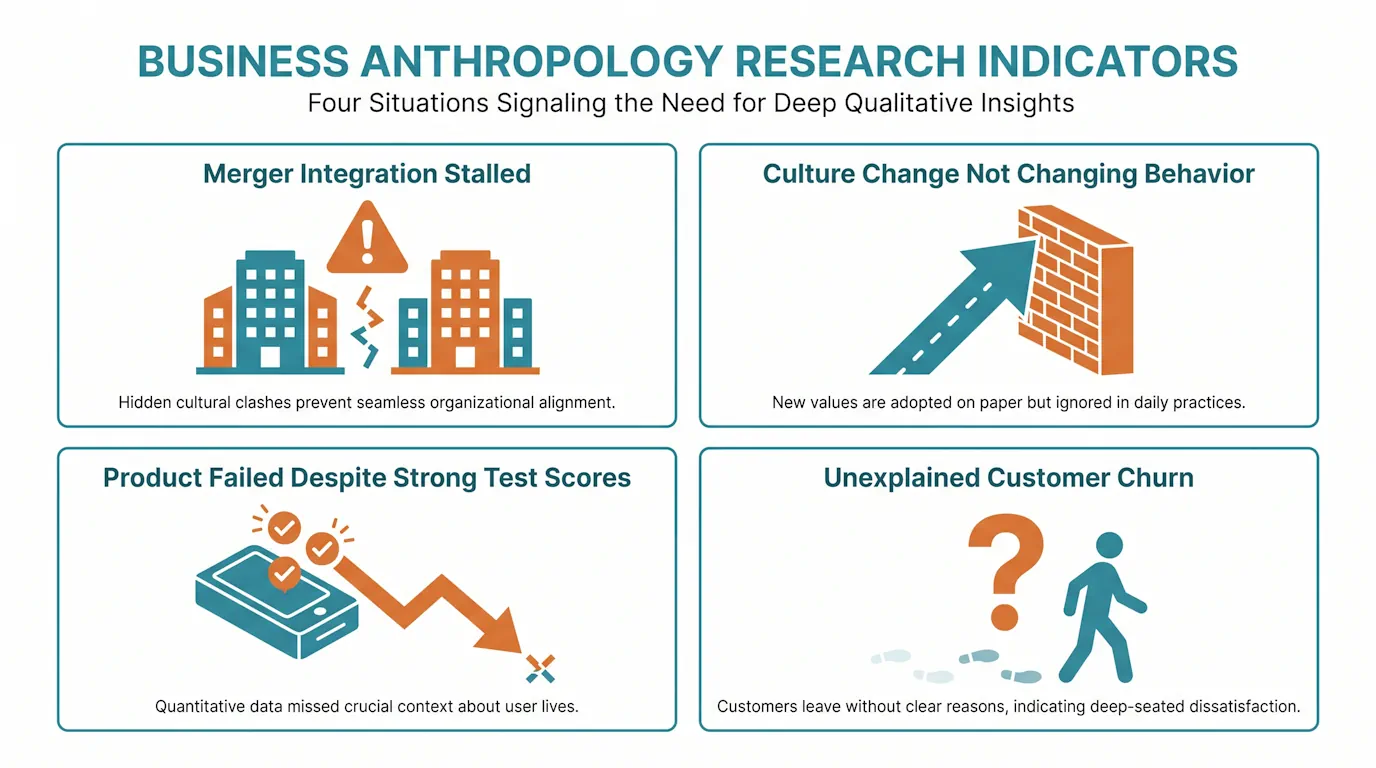
Business anthropology is not the right tool for every organizational question. It demands time, access, and a tolerance for findings that may be inconvenient. These four conditions, in practice, are where the investment consistently justifies itself.
A merger or acquisition where cultural integration has stalled is one of the clearest indicators. Two organizations that each function well in isolation frequently fail to integrate not because of strategy misalignment but because their cultures - their informal rules, communication norms, and status hierarchies - are genuinely incompatible in ways that no due diligence document captures. Ethnographic study of both organizations before and during integration maps those incompatibilities with precision that no survey can match.
A culture change initiative that has not changed behavior is the second. When leadership commits to a set of values, runs workshops, and updates the company's stated mission - and behavior remains unchanged six months later - the problem is almost always cultural rather than motivational. The new values are being translated through the existing culture's logic, which neutralizes them. An ethnographic study can identify where that translation is breaking down.
A product that strong test scores predicted would succeed, and did not, is the third. The gap between test-environment behavior and real-environment behavior is precisely what design anthropology and consumer ethnography are built to measure. Products fail in the field for reasons that are legible when you watch people using them at home, in their offices, in their real routines - and illegible in any other research setting.
Unexplained customer churn rounds out the set. When retention metrics are deteriorating and neither exit surveys nor customer service data can account for it, the explanation is frequently buried in something qualitative: a shift in how the product fits into customers' lives, a cultural signal the brand is sending that conflicts with the customer's identity, or a competitor that has found a way to be more congruent with how customers actually live. Ethnographic consumer research tends to surface those answers where nothing else has.
Frequently Asked Questions
How does business anthropology differ from standard market research?
Business anthropology observes behavior in natural settings over extended periods; standard market research collects self-reported data through surveys, focus groups, and interviews at a fixed point in time. The core difference is that anthropology captures what people do, while market research captures what people say they do - and those two rarely align.
What methods do business anthropologists use to study an organization?
The primary methods are participant observation (extended immersion in the organization's daily life), ethnographic interviewing (open-ended conversation designed to surface reasoning rather than confirm hypotheses), and artifact analysis (reading physical and digital objects as evidence of cultural priorities). Mixed methods combining qualitative and quantitative data are common in larger engagements.
How is business anthropology different from organizational psychology?
Business anthropology studies culture as its primary unit of analysis - the shared patterns, rituals, and norms that govern group behavior. Organizational psychology focuses on individuals and groups through a psychological lens, using psychometric tools and controlled studies. Each illuminates organizational life from different theoretical foundations and with substantially different methods.
Can nonprofit organizations and government agencies use business anthropology?
Yes, and many do. Despite its name, business anthropology is not confined to for-profit companies. The same ethnographic methods used to diagnose a corporation's culture apply directly to nonprofits, hospitals, schools, and government bodies - any organization where culture shapes performance and where surveys have not been able to explain what is actually happening.
How long does a business anthropology engagement take?
The timeline depends on scope and access. A focused organizational diagnostic study runs 4 to 12 weeks; a comprehensive consumer ethnography or full culture-change study runs 3 to 6 months. The depth of findings is proportional to time spent in the field - abbreviated fieldwork produces correspondingly thin results.
What triggers an organization to commission business anthropology research?
The most common triggers are: a culture change effort that has not changed behavior despite sustained leadership commitment; a merger or acquisition where integration has stalled; a product that strong test data predicted would succeed and did not; and unexplained customer churn or disengagement that standard surveys have failed to account for.
What companies have successfully used business anthropology?
Procter and Gamble, General Mills, Absolut Vodka, Samsung, and Intel are among the most-cited examples. P&G's Swiffer and General Mills' Go-Gurt were both developed from ethnographic consumer research. Samsung reshaped its television product line after anthropologists found that consumers valued large screens primarily as home decor elements, not for visual resolution.
The Discipline's Defining Commitment
Business anthropology's distinctiveness as a discipline rests on a single methodological commitment: the decision to treat observed behavior as primary evidence and self-report as secondary. That is not a rhetorical preference. It reflects decades of accumulated research showing that the gap between what people say and what they do is systematic, predictable, and consequential - and that it will not close regardless of how well a survey is designed.
For executives grappling with unexplained performance problems, stalled culture efforts, or products that miss despite strong market signals, that gap is often where the answer lives. The appropriate tools for finding it are not more surveys or better stakeholder workshops. They are the sustained, patient, immersive methods that business anthropology has refined since its emergence in organizational research in the 1920s - and that organizations like CulturalKeys apply to the specific, practical questions organizations bring to the table today.